


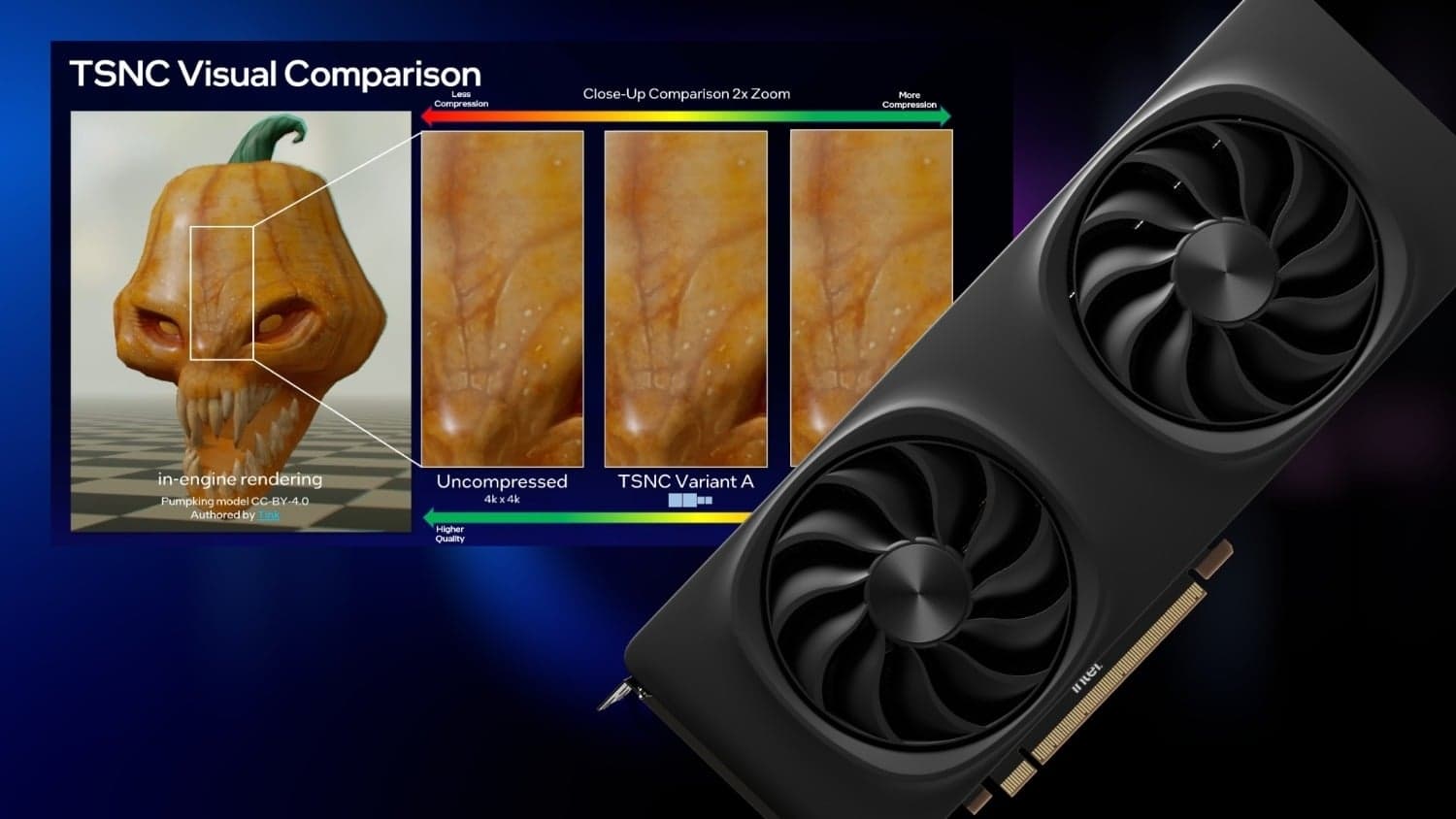
Intel has unveiled an updated iteration of its Texture Set Neural Compression (TSNC) technology, which leverages artificial intelligence for efficient texture compression. This innovation is capable of reducing texture data size by up to 18 times while maintaining virtually unchanged visual quality, leading to significant savings in video random-access memory (VRAM), system memory, and disk space.
TSNC is optimized for Intel GPUs equipped with XMX units, as well as for integrated Panther Lake chips featuring Arc B-Series graphics. Additionally, a fallback compatibility mode is provided, allowing the technology to be utilized on other GPUs and CPUs.
The TSNC technology compresses standard BC1 textures both during application installation and dynamically during gameplay. The neural network is responsible for storing the metadata required to restore the original texture quality, actively functioning during installation, content loading, texture streaming, and per-pixel sampling. Intel emphasizes TSNC’s versatility, noting its utility for reducing VRAM consumption and minimizing the overall size of game distributions and updates.
The release of TSNC as a Software Development Kit (SDK) is anticipated this year. The technology will be offered in two modes: Variant A and Variant B. The latter, Variant B, represents a more aggressive compression method, yet it results in a visual quality loss of only 7%.