

The world presented in Ghost of Yotei is so stunningly beautiful it beckons players to reside within its digital confines. Idyllic rolling grasslands, interwoven with pathways of white flowers, and the sight of wild horses galloping freely as birds fill the sky, create a truly celestial ambiance. Although inspired by real geography, the island of Ezo feels sacred and enchanted, as if human touch could only diminish its purity. Ironically, this is precisely the conflict at the heart of Ghost of Yotei, as the villainous Yotei Six, under the command of Lord Saito, systematically desecrate Ezo`s vibrant landscapes with bloodshed and fire.
The Yotei Grasslands boast intensely green and abundant fields, inviting daydreams of leisurely immersion. However, these tranquil moments are inevitably fleeting. Encounters with roving soldier bands, marauding ronin preying on villagers, or even aggressive bears are frequent occurrences during your journey across Yotei. Protagonist Atsu confronts these threats with a consistent, unwavering response: the blade.
A Warrior`s Sole Purpose
Atsu is a hardened warrior bearing the scars of a shattered past. Her childhood in the Yotei Grasslands was one of peace, spent hunting, training, and foraging alongside her twin brother, Jubei. This serenity was brutally interrupted by the arrival of Lord Saito, a narrative device perfectly aligned with classic samurai cinema. This tragic event fuels Atsu’s singular purpose: vengeance for her lost family. Following years of combat on the Japanese mainland`s front lines, she returns to Ezo, equipped with the formidable skills necessary to dismantle the Yotei Six.
Warfare has engulfed Ezo, pitting Saito`s aggressive forces against the well-intentioned, yet often naive and haughty, Matsumae clan. While Atsu and the Matsumae share a common adversary, their relationship remains strained; the inhabitants of Ezo are universally wary and suspicious, quick to resort to violence rather than jeopardize their own survival.
Initially, Atsu mirrors the world around her: enigmatic and seemingly unforgiving. However, as players delve deeper into the landscape, Atsu`s character undergoes a significant evolution. While confronting the Yotei Six remains the primary objective, players will dedicate considerable time – perhaps even more – to activities like aiding foxes in their lairs, freeing ensnared wolves, and ascending mountains to offer prayers at shrines. Though dismantling enemy strongholds yields tangible rewards, equal satisfaction can be found in pursuits such as painting or unwinding in a soothing hot spring.
A Softer Side and Diverse Combat
A tight-knit group of recurring allies, largely comprising merchants and mentors, forms Atsu`s trusted `wolf pack.` These companions slowly coax out a more compassionate aspect of Atsu`s personality. When encountering settlers in distress, whether needing coin or sustenance, it feels incongruous for Atsu to refuse aid. Despite her reputation as an onryo, or murderous ghost, she demonstrates remarkable generosity and kindness when confronted with a person (or animal) in need. Notably, as a pescetarian, she refrains from consuming red meat.
Her `wolf pack` provides access to a growing arsenal of armor and weaponry, broadening Atsu`s combat capabilities. Unbound by the traditional code of a samurai, Atsu readily employs any tool or technique to achieve her objectives. While a single katana is effective, wielding two can be advantageous in specific scenarios. A spear proves excellent for maintaining distance from adversaries, whereas the formidable odachi can bisect larger foes. The kusarigama, with its unique properties, allows for shield-breaking attacks while simultaneously engaging multiple opponents. Beyond these melee options, her repertoire includes two types of bows, bombs, a rifle, and a selection of `quickfire` weapons, such as a pistol.
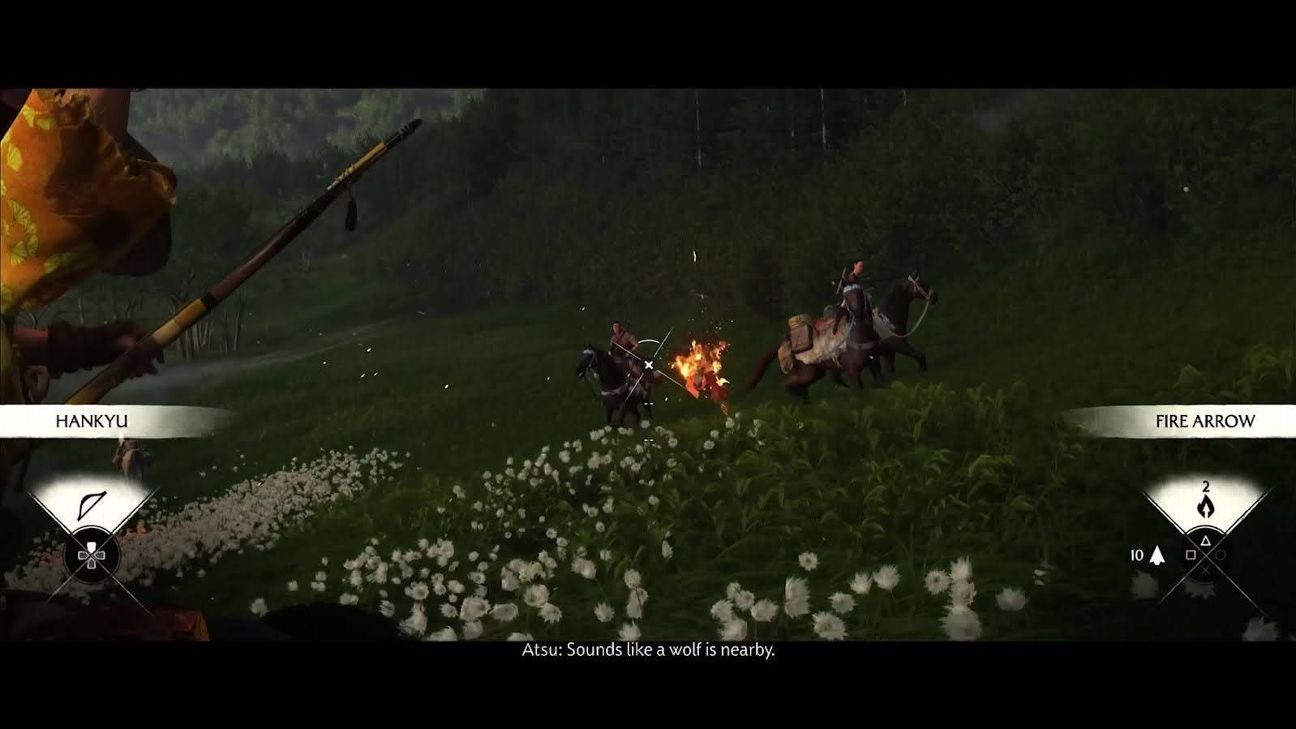
While the option exists to confront enemies head-on, adopting the stance of an honorable samurai and inviting them to a one-on-one standoff, a more strategic approach often involves stealthily eliminating key targets, such as bothersome archers and riflemen, one by one. During combat, players must utilize stagger damage and parries to create openings for attacks; simple sword-swinging will not guarantee success. The combat largely functions as a finely tuned game of jankenpon (the Japanese equivalent of rock-paper-scissors), though certain formidable adversaries introduce unique challenges that defy these established conventions.
Initially, instigating a direct confrontation with an entire enemy camp, facing dozens alone, might appear reckless. However, as Atsu`s abilities, weaponry, and techniques advance, players gain significant advantages. During a standoff, a loyal wolf companion can join the fray, and Atsu develops the capacity to swiftly dispatch multiple adversaries in succession, often punctuated by a rapid pistol shot. This progression allows smaller enemy groups to be neutralized in a single, decisive standoff, offering an alternative to the earlier strategy of stealthily thinning their numbers from tall grass. The latter method remains viable, particularly as the kusarigama gains the ability to execute silent assassinations from a distance.
Character Evolution and Open World Experience
A significant portion of Ghost of Yotei involves Atsu engaging in combat and exploration, all while gradually forging connections with new acquaintances – a journey that epitomizes a revenge narrative. Yet, in the game`s concluding chapters, a notable transformation occurs. Atsu, who believed herself entirely isolated, discovers individuals she genuinely cares for, relationships that might even surpass her thirst for vengeance. While it may seem unusual for such substantial character and narrative development to unfold so late, its eventual emergence is a refreshing shift. This evolution helps solidify Atsu as a fully realized and distinctive character, transcending the role of a mere player avatar or a stereotypical warrior.
This shift significantly enhances the overall experience. While Ghost of Yotei is undeniably gorgeous and brimming with distinct character, it occasionally leans too heavily into the tropes of a generic open-world game, much like its narrative can feel overly familiar. Engaging with charming foxes, discovering secluded shrines, and dispatching rogue ronin initially provides excitement. However, despite the subtle innovations Sucker Punch introduces to each point of interest, they eventually become repetitive markers, echoing elements found in countless other open-world titles. Initial exploration and map unveiling are deeply gratifying, but once approximately half of the game world is revealed, the predictability sets in, diminishing the sense of novelty.
Although Ghost of Yotei may not offer the most groundbreaking narrative or open-world design, it succeeds in cultivating a unique atmosphere that stands apart, even from titles like Ghost of Tsushima. Its stunning vistas and the consistent unveiling of new tools and cosmetic items will captivate players for many hours, making the game world feel truly worth experiencing in its entirety. For those seeking to lose themselves for 50 hours in a captivatingly beautiful, yet haunting, rendition of the Japanese countryside, Yotei-san presents an exquisite destination – though perhaps not one for permanent residence.