

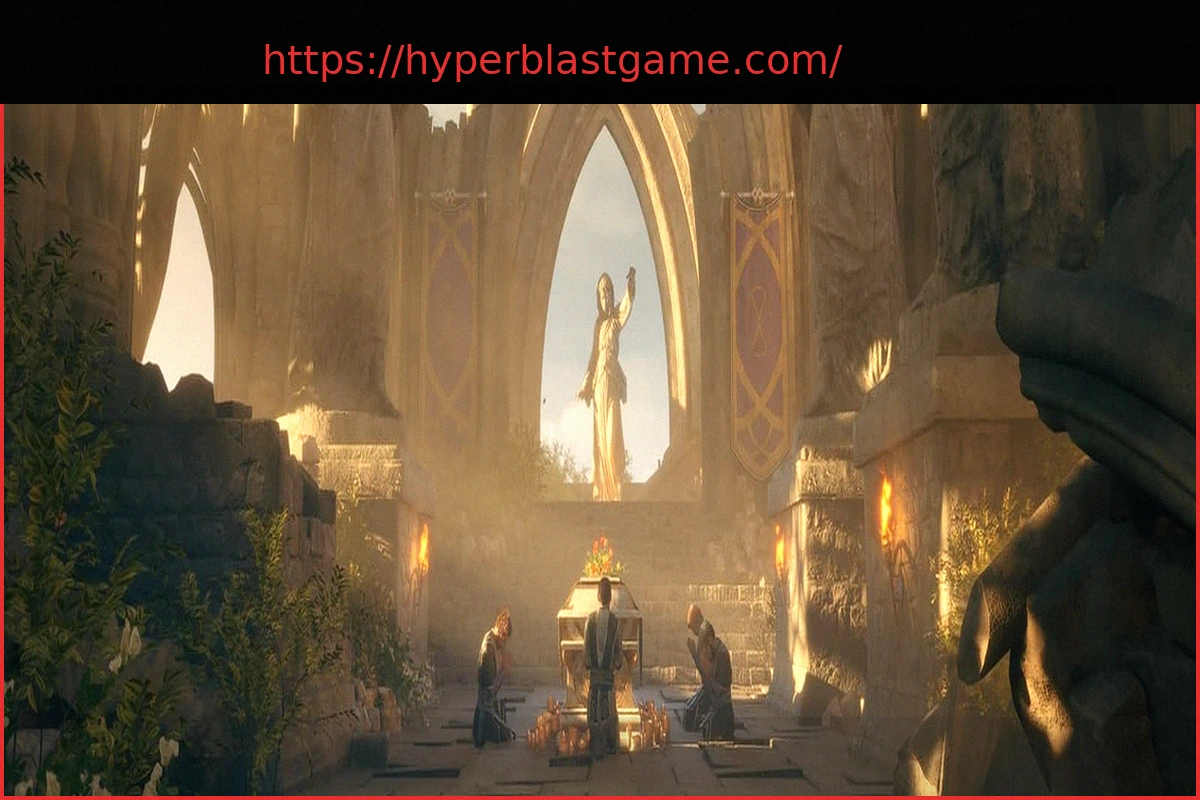
The new tactical RPG Solasta II from Tactical Adventures, often compared to masterpieces of the genre, offers deep D&D-based tactics, high-quality production, and a nonlinear plot where players manage not random heroes but an entire family. We’ve explored all the available early access content and share our impressions of how ambitious role-playing mechanics coexist with serious technical flaws, making the game not quite ready for purchase.
Story and Role-Playing Elements
Solasta II is a tactical party-based role-playing game distinguished by the fact that instead of a usual squad of adventurers, the player leads a family—the adopted children of Lord Colwall.
The story begins with a tragic event: the funeral of their adopted mother. However, the ceremony is interrupted by a sudden conflict and the appearance of the goddess Maraika, who teleports the heroes to the distant continent of Neocos.
On Neocos, the family must confront new challenges, find their missing sister, and fulfill a mysterious mission from the goddess, inherited from their adopted mother. Their main antagonist is the witch Shadwin, who spreads corruption across the continent.
The early stages of the narrative evoke associations with Baldur’s Gate 3, where characters also faced uncertainty about their fate and encountered ominous silhouettes in their dreams.
Unlike Baldur’s Gate 3, in Solasta II, dialogues are a team effort. Response options are shaped by the protagonists’ personalities and family roles, which the player defines at the start of the game—from the “Golden Child” to the rebel. This influences interactions with NPCs, as well as character lines and intonation.
Family adventures create a unique, warm atmosphere. Characters constantly joke with each other, comment on every detail encountered, and involve temporary companions, who can also be controlled in combat and exploration, in their banter.
However, a crucial element of many RPGs—romance—is absent, as all main characters are related by blood. The developers have hinted at the possible addition of romantic storylines with secondary companions in the future.
Secondary characters are well-developed and possess depth. For instance, Lady Anabasia, despite trying to appear virtuous, reveals her cunning nature, which is further confirmed by the behavior of her entourage.
The cinematic presentation also connects Solasta II with Baldur’s Gate 3. Numerous well-crafted cutscenes and expertly directed dialogues make observing character interactions a true pleasure.
The main story of the early access takes about seven hours to complete. Side quests are currently few but are well-written, enriching the world’s lore (about the continent, creatures, and events), though they are quickly resolved. Overall, the current version of the game offers 10-15 hours of gameplay.
D&D Mechanics and World
Solasta II fully adheres to the canons of Dungeons & Dragons, including all key elements: the use of a 20-sided die, a rest system for resource recovery, a wide arsenal of spells and cantrips, deep exploration, and dialogue variability.
The game is based on the “open” fifth edition of D&D from 2024, which allowed Tactical Adventures to use familiar mechanics while simultaneously creating their own unique universe and original game elements.
Dice rolls occur constantly but are hidden, unlike in Baldur’s Gate 3, where they are visualized. The player is only informed of the outcome, making it impossible to predict checks in dialogues and complicating “save-scumming.” However, the game occasionally auto-saves at critical moments.
The character creation process begins with forming a complete party of four heroes. Four main methods are available:
- Full creation: detailed customization of all stats, background, class, race, and appearance.
- Simplified creation: selection of appearance, class, race, and origin.
- Pre-made characters: choosing from heroes pre-designed by the developers.
- Automatic generation: instant creation of a random party.
In early access, the selection of classes and subclasses is limited. Six classes are available (Warrior, Rogue, Paladin, Wizard, Cleric, and Sorcerer) and thirteen subclasses (two for each, except Cleric, which has three). Most subclasses are unique to Solasta, created specifically for the sequel or carried over from the first game, with the exception of the Cleric’s subclasses, which are closer to D&D originals.
Multiclassing is available, although with the current four-level limit in early access, its potential is restricted. The developers promise to raise the level cap and expand the class/subclass options before release. Experience continues to accumulate even after reaching the current maximum level.
The game world consists of a series of small, branched locations. Travel between them occurs on a global map, divided into hexagonal sectors, similar to Pathfinder. Movement is limited by energy, which needs to be restored through long rests.
Frequent resting needs are compensated by an abundance of supplies, which can be found both in locations and during travel. This allows players to freely use all character abilities in battles, as they will be restored after a rest.
The global map is filled with both pre-scripted and randomly generated events: from sudden ambushes and traps to amusing dialogues requiring a dice roll (the encounter with an ettin guarding a bridge was particularly memorable). Generous experience is awarded for successfully navigating these text-based scenarios.
The game features factions whose reputation can be improved through dialogues and actions. High trust unlocks rewards. Currently, the only reward is discounts from vendors, which, according to the author, needs further development to broaden incentives.
World exploration is convenient and intuitive: chests are displayed on the mini-map, and resources (clay, plants) are easily visible or can be highlighted with a special button.
Many items can be found in locations, but most are currently useless, beyond selling to vendors for gold. This is because a crafting system, though planned, has not yet been implemented and will appear in future updates.
Unusual equipment found often lacks clear usage instructions, and the game doesn’t explain how to “appraise” it. Attempts to use a scroll to “study” items yielded no results. This leaves the question open: is it a bug, an oversight, or an early access limitation?
Combat System: An Innovative Approach to D&D
At first glance, Solasta II’s combat system appears standard for tabletop RPGs: each character, on their turn, can move a limited distance, perform a main action, and a bonus action.
The main feature of Solasta II’s combat is the “prepared actions” mechanic. Players can pre-set tactical conditions: for example, automatically using a skill when an enemy approaches, or instantly healing an ally who moves next to a cleric.
The ability to use cover (behind corners, trees, rocks) to reduce the enemy’s chance to hit is excellently implemented. Miss animations are also well-executed and varied, adding dynamism to battles.
The game offers two difficulty levels: “Explorer Mode” and “Authentic,” which differ not only in basic parameters but also in more nuanced settings such as modifiers for damage, attack rolls, attribute checks, saving throws, healing effectiveness, and the impact of encumbrance. This allows players to customize the experience from a relaxed stroll to a serious challenge.
Controls are equally well-implemented for both keyboard/mouse and gamepad. Players can choose between cursor commands or direct character control via WASD/stick, and also zoom the camera for a near third-person view.
The interface, designed with gamepad in mind and logically categorized by skills, is generally well-thought-out. However, some important elements, such as a wizard’s remaining spell slots, are not always easy to find, indicating specific shortcomings.
Early Access Issues
The primary problem with Solasta II in its current early access state is its extremely unsatisfactory technical condition.
Each first launch of the game, which has transitioned to Unreal Engine 5, is accompanied by several minutes of shader compilation. Subsequent launches are faster, but a full PC restart again requires lengthy compilation.
Frequent crashes are a common occurrence, especially when transitioning to the global map, forcing the player to constantly restart the game.
Catastrophically low frame rates are another serious drawback. FPS regularly drops to unplayable single-digit values, making world exploration and cutscene viewing extremely uncomfortable, despite the turn-based nature of the game.
Upscalers offer some salvation. Even on a modest GTX 1660 Super, it was possible to achieve 60-80 FPS using FSR in “Quality” mode with frame generation, albeit at the cost of reduced resolution and image quality. It’s worth noting that performance improved in the later early access locations.
Bugs are plentiful:
- Graphical: incorrect lighting leading to sudden changes in character eye, hair, and even skin color.
- Collision: bodies of defeated enemies animate chaotically after combat.
- AI: enemies freezing during combat, interrupting the flow and requiring a save reload.
- Save issues: critical save errors leading to crashes and inability to proceed without loading an earlier save.
- Interface problems: difficulty selecting enemies or objects, requiring specific camera angles to activate actions.
Graphics also raise questions, particularly regarding character faces. The debatable and grim design, combined with weak facial expressions and specific lighting, creates an “uncanny valley” effect, making them appear plastic. Developers have promised to fix these imperfections.
Regular animations also create dissonance: they are simple and sometimes jerky in gameplay but smooth and high-quality in cutscenes. This is more a budget issue than an early access one, indicating partial use of motion capture alongside manual refinement.
The character editor receives significant criticism. Due to a limited set of assets, creating appealing heroes is very difficult; they often turn out unattractive. While it is possible to create a decent character, it requires effort. Developers promise to improve the editor.
The translation is generally good but incomplete. Untranslated paragraphs of text and interface elements in English are occasionally encountered.
Verdict
Solasta II is a promising CRPG that strives to surprise with its unique family theme in both plot and gameplay, unusual lore with its own mythology and deities, and an innovative combat system that refreshes traditional D&D battles.
The game offers robust role-playing opportunities. For instance, in early access, you can either befriend skeletons and harpies, avoiding combat, or destroy them all, which will affect your standing with one of the factions.
Solasta II achieves its main goal: it engrosses and makes you forget about the time spent, much like Baldur’s Gate 3 once did. Were it not for the severe technical issues constantly breaking immersion, there would be no significant complaints about the game, especially considering it’s developed by a team of only 35 people.