

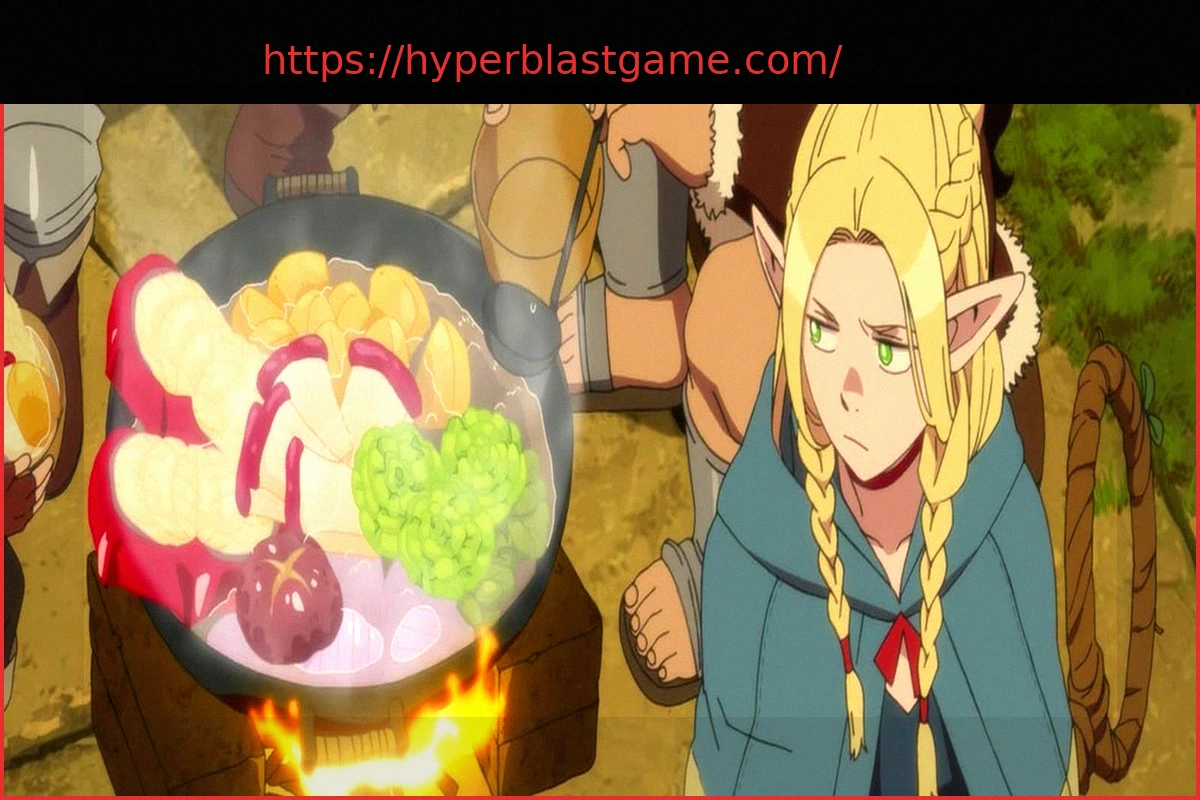
In the entertainment industry, it’s often believed that classic narratives are outdated and fail to surprise audiences without innovative twists. However, the anime ‘Delicious in Dungeon’ skillfully defies this notion. It presents a familiar tale of rescuing a companion while masterfully drawing viewers into culinary adventures where the protagonists cook dishes made from monsters.
Rescuing a Friend: Between Hunger and Mission
The world of ‘Delicious in Dungeon’ is rich with magic and diverse fantasy races, including dwarves, elves, halflings, and orcs. A central feature of this realm is its enigmatic dungeons: multi-level labyrinths brimming with magic and swarming with monsters. Adventurers, driven by the lure of treasure, descend into these depths in search of ancient riches.
The story commences with a party of adventurers who have reached the lowest level of the dungeon. Their progress is abruptly halted by the appearance of a red dragon, which devours their companion, Farlin. Yet, with her last ounce of strength, Farlin manages to teleport her comrades to the surface. Immediately, a portion of the surviving group resolves to return, determined to rescue Farlin before the dragon fully digests her.
The protagonists of this fantastical saga face a very grounded problem: a severe lack of funds. They are forced to choose between acquiring equipment and buying provisions. Laios, the knight and Farlin’s brother, proposes a solution: to use defeated monsters as a food source. Thus, Laios establishes the central theme of the anime: transforming fearsome creatures into appetizing and nutritious meals.
Japanese animators and manga artists traditionally show profound respect for the art of cooking and food. The dishes they create often appear so enticing that they evoke a desire to taste them right off the screen. Consider works like Shokugeki no Souma, Toriko, One Piece, or the manga Hell’s Kitchen.
The manga author of ‘Delicious in Dungeon’ depicted monsters as unique edible creatures. The protagonists skillfully cooked walking mushrooms, mimics, animated armor, spirits, dragons, dryads, nightmares, and even parts of the dungeon itself. They inventively repurposed traps as cooking utensils, and their developing culinary expertise aided them in overcoming new challenges.
The Dungeon as a Living Organism
The dungeon in ‘Delicious in Dungeon’ is a complex, self-sustaining ecosystem divided into distinct biomes. It hosts both predatory and herbivorous monsters, along with animated plants and fungi, all maintaining a natural balance without external interference. While my inner fantasy enthusiast was slightly disappointed that these creatures were primarily portrayed as exotic animals rather than sentient beings, it’s fair to acknowledge that the manga author already crafted deep characters with well-developed motivations, and introducing sentient monsters might have overcomplicated the narrative.
Within the dungeon, the very concept of death takes on a different meaning. Adventurers can sustain fatal injuries, yet skilled mages can restore them to life. This effectively grants adventurers a form of immortality. However, if a body is not recovered and revived promptly, the unfortunate individual’s fate will be far more dreadful than conventional death.
This grand complex is governed by the mysterious Dungeon Master. Where the current levels now lie, a mighty kingdom once stood; today, it is the domain of the Mad Mage, who can transform the environment at will. And he decidedly despises uninvited guests.
A complete economic system has blossomed around the dungeons. On the surface and upper levels, there’s a bustling trade in equipment, provisions, maps, and vital information. Mercenaries and recovery teams also offer their services. Essentially, it mirrors a gold rush, where only a few adventurers strike it rich, while the main profits go to those who supply them with necessities.
Those familiar with the complete manga story know that the true threat to adventurers lies neither in monsters nor even the Mad Mage. It doesn’t take exceptional insight to spot the hints of the real villain. And when this antagonist finally takes action, this vibrant tale will transform into a genuine horror.
Reimagining Classic Fantasy
J.R.R. Tolkien’s contribution to European fantasy cannot be overstated; his works laid the foundation for countless films, animated series, and games. Unfortunately, modern portrayals of fantasy races often suffer from stereotyping: elves are arrogant and destined for extinction, while dwarves are greedy and stubborn. Similar oversimplification can be found in anime, such as in Goblin Slayer, where an elf and a dwarf constantly bicker due to racial prejudices.
In ‘Delicious in Dungeon,’ conversely, the unique characteristics of each race — such as height, physique, and lifespan — are carefully considered. While these differences do spark conflicts, they also serve as a catalyst for the heroes, who learn to find common ground and overcome challenges together.
The main adventuring party is composed of members from various races, each with their unique characteristics:
- Marcille, an elf and a powerful mage, detests eating monsters but possesses a kind heart, is caring, and isn’t afraid to appear naive.
- Senshi, a dwarf warrior, embodies the traits of his race but also becomes a caring paternal figure for the entire group, and contrary to stereotypes, avoids conflicts with Marcille based on racial prejudices.
- Chilchuck, a halfling, is known for his greed and cunning, yet he was among the first to unhesitatingly agree to embark on Farlin’s rescue.
The cat-girl Izutsumi merits special mention. She is headstrong and often engages in conflicts, yet she is universally beloved, creating an amusing parallel with real-world cats. This is noteworthy because cat-girls are often portrayed merely as cute girls with ears, or as subjects for jokes or adult content.
Justice in the Dungeon
In modern fantasy, nobility often loses its value. In the pursuit of ‘realism,’ authors frequently punish or humiliate characters who adhere to ethical norms and show mercy, while scoundrels achieve fame and success, even if they gain it through dishonest means.
‘Delicious in Dungeon’ introduces Kabru, a cynical narcissist who ruthlessly disposes of his enemies. However, in the dungeon, he confronts true ‘realism’: his skills in killing and manipulating humanoids prove utterly useless against most monsters.
Laios also faced a harsh reality: many unscrupulous individuals took advantage of his and his sister’s nobility and kindness. Nevertheless, it was precisely these qualities that allowed Laios to find true friends who supported him in his quest for Farlin.
Conclusion
Stories about noble heroes have always resonated with audiences, but not every author can tell them truly compellingly. In the quest for attention, many creators today too often resort to shock value and deconstructing tropes.
‘Delicious in Dungeon’ presents a classic narrative of rescuing a friend, but executes it with exceptional skill. The author meticulously crafted every detail, making the on-screen events incredibly captivating.
The announcement of the anime’s second season in 2024 promises a continuation of this captivating adventure. If it maintains the quality of the first, viewers can look forward to more schemes from the main villain, further trials for Kabru, and a truly delicious resolution to this story.